


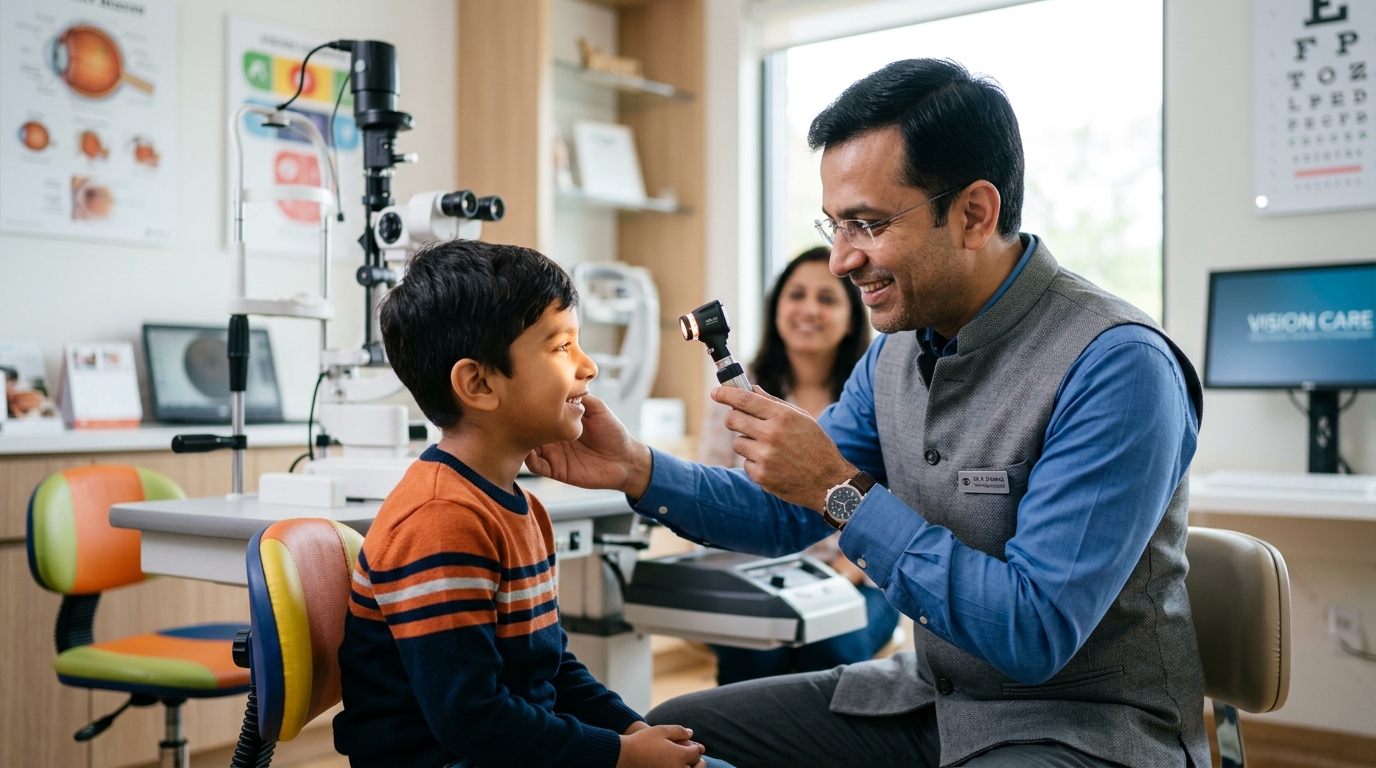
Over 80% of a child’s early learning and development happens visually. However, young children rarely complain of blurry vision—they simply adapt to seeing incorrectly because they assume everyone sees the world the same way.
Warning Signs Parents Should Watch For
Parents and teachers can spot potential vision issues by observing everyday habits:
- Frequent Eye Rubbing & Blinking: Indicates eye fatigue, dry eyes, or uncorrected refractive power.
- Squinting or Tilting Head: Narrowing eyes or turning the head sideways to see distant objects or TV clearly.
- Sitting Very Close to Screens: Holding books or tablets unusually close to the face.
- Difficulty Concentrating or Headaches: Frequent complaints of tiredness or headaches after reading or schoolwork.
- Misaligned Eyes (Squint/Strabismus): One eye drifting inward or outward, especially when tired.
Common Paediatric Eye Conditions
- Myopia (Nearsightedness): Rapidly increasing among kids due to excessive screen time and reduced outdoor play.
- Amblyopia ("Lazy Eye"): Occurs when one eye has significantly worse vision, causing the brain to favor the stronger eye. If untreated before age 8-9, permanent vision loss can occur.
- Strabismus (Crossed Eyes): Misalignment of eye muscles preventing both eyes from focusing together.
"Catching vision issues like amblyopia before the age of 7 yields the highest rate of complete visual recovery and preserves 3D depth perception." — Dr. Kumar Sambhav
Child-Friendly Solutions at EyeNexa
- Paediatric Vision Screening: Painless, interactive retinoscopy and streak screening designed for children of all ages.
- Myopia Management: Specialized optical lenses and low-dose atropine eye drops to slow down myopia progression.
- Vision Therapy & Patching Regimens: Structured occlusion therapy to strengthen lazy eyes and restore binocular vision.
- Durable & Safe Frames: Flexible, impact-resistant polycarbonate glasses tailored for active children.